Ploughing Marker
Basic info
Among the key indicators of effective agricultural land management is the detection of ploughing activity. The ploughing marker plays a critical role in confirming field maintenance and ensuring compliance with regulations, especially as subsidies shift towards more environmentally conscious practices. In regulatory scenarios, it is important to determine whether fields are ploughed during restricted periods when such activity is prohibited.
The ploughing marker serves the crucial purpose of identifying periods when a field has been ploughed, resulting in exposed bare soil. While ploughing activity may not be directly observable in satellite imagery such as Sentinel-2 or Analysis Ready Planet Scope data, its effects manifest over time and can be detected through careful analysis of signal values.
Further info
Ploughing induces a rapid transition from vegetated to bare soil surfaces, a transformation that registers in signal values as a notable increase in bare-soil probability. The higher this probability, the more confidently we can infer the presence of freshly ploughed soil. By observing a sharp and substantial rise in this probability, we can determine when ploughing occurred. The start of the ploughing interval is marked by the onset of this increase, while its end is signified by a plateauing of the probability value.
Signal relationships: It is worth noting the inverse relationship between bare-soil probability and NDVI (Normalized Difference Vegetation Index) values, which reflect vegetation vigor. When bare-soil probability is high, NDVI values tend to be low, indicating diminished vegetation cover.
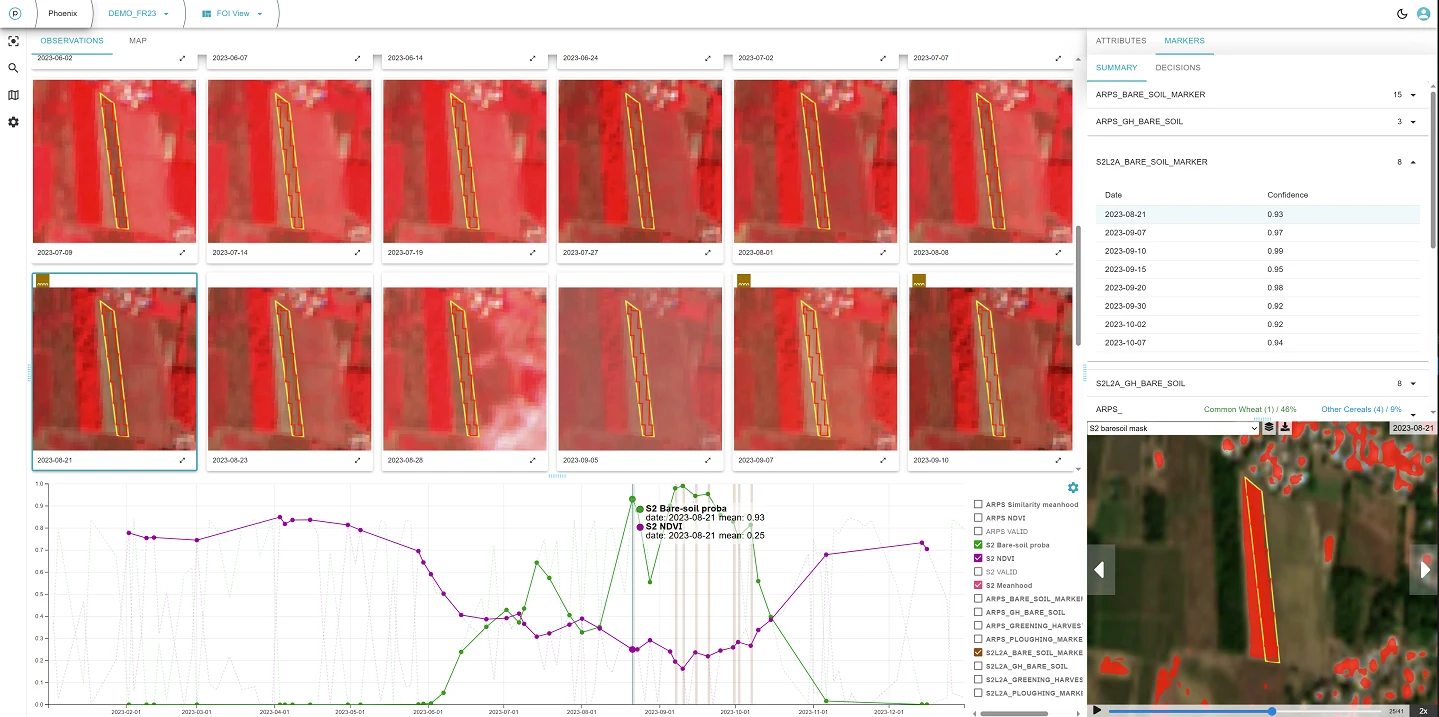
Example case: The wheat field 92276773 shown below was vegetated until the end of May and had exposed bare soil between August and October. In this same period, we observe a distinct increase in the bare-soil probability and drop in NDVI value, which indicates the field was ploughed.
Marker output
The output of the marker consists of ploughing events, defined by distinct dates during the period when the bare-soil probability significantly increased, and corresponding bare-soil probabilities on these dates. Users can control the number of false positive and false negative events by setting marker parameters, such as the required magnitude of rise in bare-soil probability for an event to be valid.
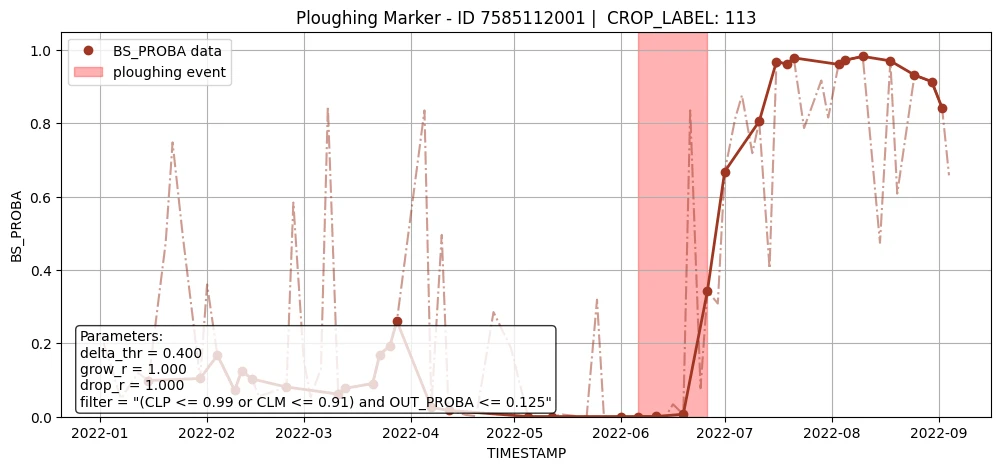
For a detailed description of the ploughing marker output, check the Marker Service API documentation.
Links
Blog post about Bare-soil marker